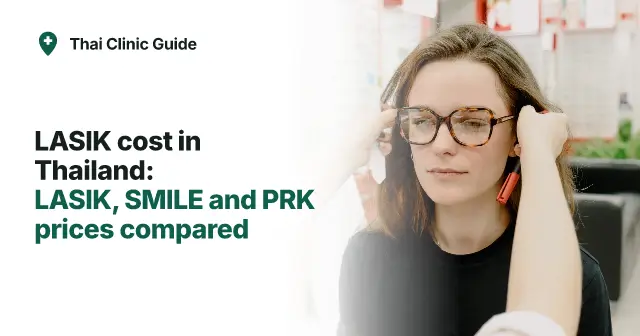
Bangkok eye care compared: hospital eye centres, a dedicated eye hospital and a standalone laser centre, for LASIK, SMILE, cataract surgery and retina care. Check services, staff, fees and availability with each provider before you book.
Laser vision correction is offered by hospital centres and standalone specialist centres; some hospital eye clinics focus on cataract and glaucoma instead.
Several Bangkok providers publish packages, but some exclude the consultation, pre-operative tests or the lens implant itself.
Laser packages often include a set number of follow-up visits over months, which matters if you are flying home.
A dedicated eye hospital puts subspecialists for cornea, retina, glaucoma and children's eyes on one site.
Our method for this page
We read each provider's own web pages on eye hospitals and clinics in Bangkok and kept only statements we could trace to a source. Nobody paid to be included, and the list is not a quality ranking. Criteria:
Bumrungrad's Eye Center occupies the 18th floor of Building A, with 13 treatment rooms and a page listing 39 doctors across nine subspecialties, from cornea and refractive surgery to retina, glaucoma, paediatric ophthalmology and neuro-ophthalmology. A refractive surgery centre within it offers ReLEx SMILE, femtosecond LASIK and PRK.
Cataract surgery is listed with phacoemulsification and lens implants, supported by the ORA intra-operative aberrometry and VERION image-guided systems. Other published work includes corneal transplants and cross-linking, vitrectomy and intravitreal injections, glaucoma laser and surgery, eye muscle surgery and children's eye examinations.
Packages are published with a validity date of 31 December 2026: ReLEx SMILE for both eyes at 102,000 THB, including five follow-up visits within six months, ICL from 129,000 THB per eye and monofocal cataract surgery at 85,400 THB per eye. It may suit patients who want eye surgery inside a large hospital with other specialists on hand.
39 ophthalmologists listed
ReLEx SMILE, LASIK and PRK
ORA and VERION systems for cataract surgery
Published packages valid to 31 Dec 2026
Open daily 08:00–20:00
Eye Center, Building A, 18th floorDaily 08:00–20:00+66 2 066 8888
Worth confirming: Package prices exclude the initial consultation and suitability tests, and the cataract package covers only the lens types it specifies; confirm the lens and total cost.
JCI clinical care programme certifications (stroke, acute coronary syndrome, lung cancer, orthogeriatric; listed to 2027)
Bangkok Hospital splits eye care between an Eye Center on the 5th floor of Building D, with subspecialty clinics for cornea, oculoplastics, glaucoma and LASIK, and a dedicated LASIK Center on the 5th floor of the Bangkok Hospital Building. The hospital says its eye care programmes are JCI accredited.
Refractive options include ReLEx SMILE, FemtoLASIK, FemtoLASIK Presbyond for people needing reading correction, PRK and ICL lenses. Cataract surgery is offered with monofocal, toric, trifocal and EDOF lenses, and the eye surgery list also covers pterygium, eyelid, tear-duct, squint and glaucoma operations.
Fly-in packages valid to 31 December 2026 price SMILE and FemtoLASIK at 101,000 THB and PRK at 71,000 THB for both eyes, including five follow-up visits over six months. Cataract surgery starts at 69,000 THB per eye, but that figure excludes the lens implant. It may suit patients who want laser and cataract options under one hospital group.
Separate Eye Center and LASIK Center
SMILE, FemtoLASIK, Presbyond and PRK
Fly-in packages valid to 31 Dec 2026
Five follow-up visits in laser packages
JCI accredited eye care programmes (hospital's statement)
LASIK Center, 5th floor, Bangkok Hospital Building; Eye Center, 5th floor, Building DLASIK Center: Mon–Sat 08:00–17:00; Sun 08:00–16:00. Eye Center: Mon–Fri 08:00–19:00; Sat 08:00–17:00; Sun 08:00–16:00+66 2 755 1307
Worth confirming: Cataract package prices exclude the lens implant, and a separate online FemtoLASIK offer (88,000 THB) is limited to Thai citizens and expatriates buying online.
Samitivej Sukhumvit's Eye Clinic sits on the 4th floor of the hospital's Sukhumvit Wing and says it has been treating patients for more than 25 years with a team of certified ophthalmologists and nurses. It is open daily, and the hospital says its eye doctors can be reached by phone outside clinic hours.
The published service list is centred on medical and surgical eye care rather than laser vision correction: cataract surgery using phacoemulsification and lens implants, glaucoma surgery, squint correction, and treatment of pterygium and diabetic eye disease. Diagnostic equipment named includes autorefraction, eye-pressure measurement, a fundus camera and a computerised visual field analyser, with YAG and argon laser rooms.
No eye surgery prices are published for this branch. It may suit Sukhumvit residents and visitors who need cataract, glaucoma or general eye care within a full-service hospital.
Rutnin is a standalone eye hospital on Sukhumvit 21 (Asoke), founded by Professor Dr Uthai Rutnin and now listing more than 39 ophthalmologists. Its doctors cover cornea and refractive surgery, cataract, glaucoma, retina and vitreous, uveitis, oculoplastics, neuro-ophthalmology, ocular oncology and children's eye care, which is run as a separate Rutnin Children's Eye Center.
Laser vision correction is provided through the Rutnin-Gimbel LASIK Centre, and the hospital also lists phakic lens implants for high short-sightedness. Its technology timeline includes an excimer laser, IOLMaster 700, Pentacam, Optos retinal imaging and a Zeiss Cirrus OCT, alongside corneal transplant techniques such as DMEK.
Prices for international patients are published for screening packages, such as a cataract screening at THB 4,400. A cataract surgery package is listed, but its page excludes doctor fees, consultation and pre-operative tests. Rutnin may suit patients who want a hospital that does nothing but eyes, with subspecialists on one site.
More than 39 ophthalmologists
Rutnin-Gimbel LASIK Centre
Separate children's eye centre
Inpatient care 24 hours
Screening packages priced for foreign patients
Outpatient: Mon–Sat 08:00–20:00; Sun 08:00–19:00; public holidays 08:00–17:00
Worth confirming: The cataract surgery package excludes doctor and consultation fees and lenses outside the package; ask for an itemised quote naming the lens.
TRSC is a standalone eye centre on the sixth floor of the U Chu Liang Building on Rama IV Road. It describes itself as Thailand's first private standalone centre to perform LASIK and ReLEx SMILE and says its doctors have treated more than 102,000 eyes. Medical Director Dr Ekktet Chansue leads a team of named full-time refractive and cataract surgeons, with retina and glaucoma specialists alongside.
Laser options run from PRK and LASIK to FemtoLASIK, ReLEx SMILE and SMILE Pro, with ICL lens implants as a non-laser option. Cataract surgery is offered with monofocal, toric, multifocal and EDOF lenses, and refractive lens exchange is listed for presbyopia.
Its fee tables are itemised: LASIK or PRK by a specialist costs 89,000 THB for both eyes, SMILE packages start at 129,000 THB, and cataract surgery runs from 85,000 THB per eye. Most laser and cataract fees include five follow-up visits over a year. It may suit patients comparing laser options on price.
Over 102,000 eyes treated (centre's figure)
SMILE Pro, SMILE, FemtoLASIK, LASIK and PRK
ICL and toric ICL
Fee tables published by procedure and surgeon
Open seven days
6th Floor, U Chu Liang Building, Rama IV Road, Silom
Worth confirming: ICL fees are per eye and need a separate 60,000 THB lens deposit per eye; confirm which surgeon your quoted package uses.
How to compare eye hospitals and clinics in Bangkok
Most people looking for an eye clinic in Thailand want one of two things: laser vision correction to reduce their need for glasses, or cataract surgery. Both are usually quick operations, but the outcome depends on a thorough assessment beforehand, a surgeon with the right subspecialty and enough time afterwards for check-ups before you fly home.
This guide is general information, not medical advice: only an ophthalmologist who has examined your eyes can say whether a procedure suits you.
Checking the ophthalmologist
Every doctor in Thailand must hold a licence from the Medical Council of Thailand, whose public lookup at tmc.or.th lets you search by first name and surname and shows licence status and any recorded specialty. Enter the name exactly as the clinic gives it, and ask for the licence number if a search returns several results.
Ophthalmology training and the Thai Board of Ophthalmology examinations are overseen by the Royal College of Ophthalmologists of Thailand. Beyond board certification, many surgeons list a subspecialty such as cornea and refractive surgery, retina and vitreous, glaucoma or paediatric ophthalmology. For laser vision correction, a cornea and refractive surgeon is the usual fit; for a complex cataract or a retinal problem, look for the matching subspecialty.
Before your consultation, the UK Royal College of Ophthalmologists' standardised patient leaflets and surgery checklist for refractive surgery are a useful way to prepare questions; it also expects provider information to set out fees, possible extra costs and aftercare.
Laser vision correction: who is suitable
The American Academy of Ophthalmology (AAO) says LASIK candidates should usually be at least 18, ideally over 21, with a prescription that has been stable for at least a year and healthy corneas of sufficient thickness. Conditions that can rule it out include keratoconus, severe dry eye, thin or scarred corneas, advanced glaucoma, a cataract affecting vision and poorly controlled diabetes. At least one Bangkok hospital also excludes pregnancy, breastfeeding and recent isotretinoin (acne medication) use.
A proper pre-operative assessment takes time. Expect refraction, corneal thickness measurement and corneal mapping, a tear-film check and a dilated examination of the retina. You will usually be asked to stop wearing contact lenses beforehand (one Bangkok hospital asks for three days for soft lenses and seven for hard), because lenses change the shape of the cornea and can distort the measurements.
LASIK, SMILE and PRK in brief
All three reshape the cornea with a laser. LASIK cuts a thin flap, now usually with a femtosecond laser ("FemtoLASIK"), then reshapes the tissue underneath with an excimer laser. SMILE uses a femtosecond laser to shape a small disc of tissue inside the cornea, which is removed through a small incision, so there is no flap; it is used for short-sightedness and astigmatism. PRK removes the surface layer instead of making a flap, which avoids flap risks but brings a slower, more uncomfortable recovery while the surface heals.
For prescriptions outside the laser range, or corneas that are too thin, clinics may offer an implantable Collamer lens (ICL), placed inside the eye in front of the natural lens. None of these treatments stops presbyopia, so most people still need reading glasses from their mid-forties. Common, usually temporary side effects include dry eye, glare, halos and fluctuating vision; the NHS says these normally improve within a few months.
Cataract surgery and lens choices
Cataract surgery replaces the clouded natural lens with an artificial intraocular lens (IOL), most often by phacoemulsification under local anaesthetic. When both eyes need surgery they are often treated on separate days; the NHS notes that some lens surgery is done this way.
The lens choice drives much of the price. Monofocal lenses focus at one distance, usually far, and most people then need reading glasses. Toric lenses also correct astigmatism. Multifocal, trifocal and extended depth-of-focus (EDOF) lenses aim to reduce dependence on glasses, but the AAO warns they can cause glare, halos and some loss of contrast, which matters if you drive at night.
In published Thai prices, cataract surgery on one eye runs from roughly 69,000 THB to over 140,000 THB depending on the lens and the hospital. Some quotes exclude the lens implant itself, so check what is included before comparing.
What a package usually includes
Thai hospitals and eye centres often sell refractive and cataract surgery as packages. Read the terms line by line, because two packages with the same headline price can cover very different things.
Whether the pre-operative assessment and specialist consultation fee are included or charged separately
Whether prices are per eye or for both eyes
Which lens model or laser platform is covered, and what an upgrade costs
How many follow-up visits are included, and over what period
Post-operative eye drops and medication
Any enhancement (re-treatment) policy and its cost
Whether the price is only for certain patients, such as fly-in or online buyers
What happens to your payment if the surgeon finds you unsuitable
Aftercare, follow-up and flying
Most laser and cataract surgery is done as a day case, but follow-up matters. One published Bangkok fee table, for example, schedules checks the next day, at one week, one month, three months and one year. Plan to stay at least until your surgeon is happy with the one-week check, and agree how later reviews will happen once you are home.
Follow the instructions you are given on eye drops, wearing a protective shield at night, and avoiding rubbing your eyes, swimming and dusty environments. The NHS advises not driving until your vision has recovered. Ask your surgeon for a written date before you fly. This is especially important after retinal surgery: the NHS says you must not fly while a gas bubble remains in the eye, which can be for up to 12 weeks.
Before you leave, ask for a written report with your pre-operative measurements, the procedure and laser used, and the lens model and power implanted. The UK government notes that full medical reports are not always readily available in Thailand, so request yours before discharge.
Costs, deposits and insurance
Private hospitals in Thailand typically take a deposit or payment before treatment, according to the UK government. Some eye packages are sold at a different price to residents, international patients or online buyers, so make sure the quote you hold applies to you.
Laser vision correction is elective and rarely covered by travel or health insurance. Cataract surgery may be covered by some health policies, so check with your insurer before booking and ask the hospital for itemised receipts and a medical report for any claim.
Questions to ask before you book
Who will perform my surgery, and can I check their Medical Council licence and subspecialty?
What tests will the pre-operative assessment include, and how long before it must I stop wearing contact lenses?
Based on my measurements, which procedure do you recommend and why not the alternatives?
Is the price per eye or for both eyes, and does it include the assessment, consultation and eye drops?
Which laser platform or lens model is included, and what does an upgrade cost?
How many follow-up visits are included, and when should I first be able to fly?
What is your policy and fee if I need an enhancement or further treatment?
What happens to my payment if you find I am not suitable?
Who do I contact if I have a problem after returning home?
Will I receive a written report with my measurements and the lens or procedure used?
Warning signs
A firm price or procedure offered before any examination of your eyes.
No pre-operative assessment, or one rushed into the same visit as surgery without time to consider the results.
The clinic will not name the surgeon or give their full name so you can check their licence.
Guarantees of perfect vision or no need for glasses, or outcome claims with no source.
Pressure to book quickly, or discounts that end the same day.
No clear follow-up plan, or encouragement to fly home the day after surgery.
Published both-eye packages from Bangkok providers run from about 89,000 THB for LASIK or PRK to 129,000 THB or more for some SMILE packages, depending on the procedure and surgeon. Check whether the price is per eye or both eyes, what follow-up is included and whether the initial assessment is extra.
Does a Bangkok cataract surgery price include the lens?
Not always. One hospital's cataract package excludes the lens implant, and another provider's excludes doctor and consultation fees. Ask for an itemised quote that names the lens model and type, as the lens drives much of the price.
How long should I stay in Bangkok after laser eye surgery?
Plan to stay at least until your surgeon is happy with the one-week check, and ask for a written date before flying. Published Bangkok fee tables schedule follow-up visits from the next day to a year after surgery, so agree how later checks will happen at home.
Am I suitable for laser eye surgery?
Only an assessment can tell. Clinics measure corneal thickness and shape, check for dry eye and examine the retina, and usually ask you to stop wearing contact lenses beforehand. If you are unsuitable for laser, some Bangkok providers offer implantable lenses (ICL) instead.
About the writer and reviewer
PS
Pimchanok Srisawat
Health writer
Writes guides and comparisons for Thai Clinic Guide, keeping a link to the page behind every detail so readers can check it themselves.
KW
Kittisak Wongsawat
Health writer and reviewer
Goes through pages line by line against the sources listed, and flags wording that could be taken as advice for one reader.
This page sets out published information and is not medical advice. Speak to a doctor before you choose treatment. Our method.

 Private tertiary hospital